AlcoLab
Accessible methanol screening for everyone
Free, open-source tool that estimates methanol contamination in alcoholic beverages and hydroalcoholic solutions — no lab required.
Screening tool — does not replace confirmatory laboratory analysis.
How it works
Experiment
The app guides the user through two measurements for both the sample and water (reference standard):
- Relative density — ratio of the sample mass to the water mass (same volume, same temperature), obtained by differential weighing with a syringe.
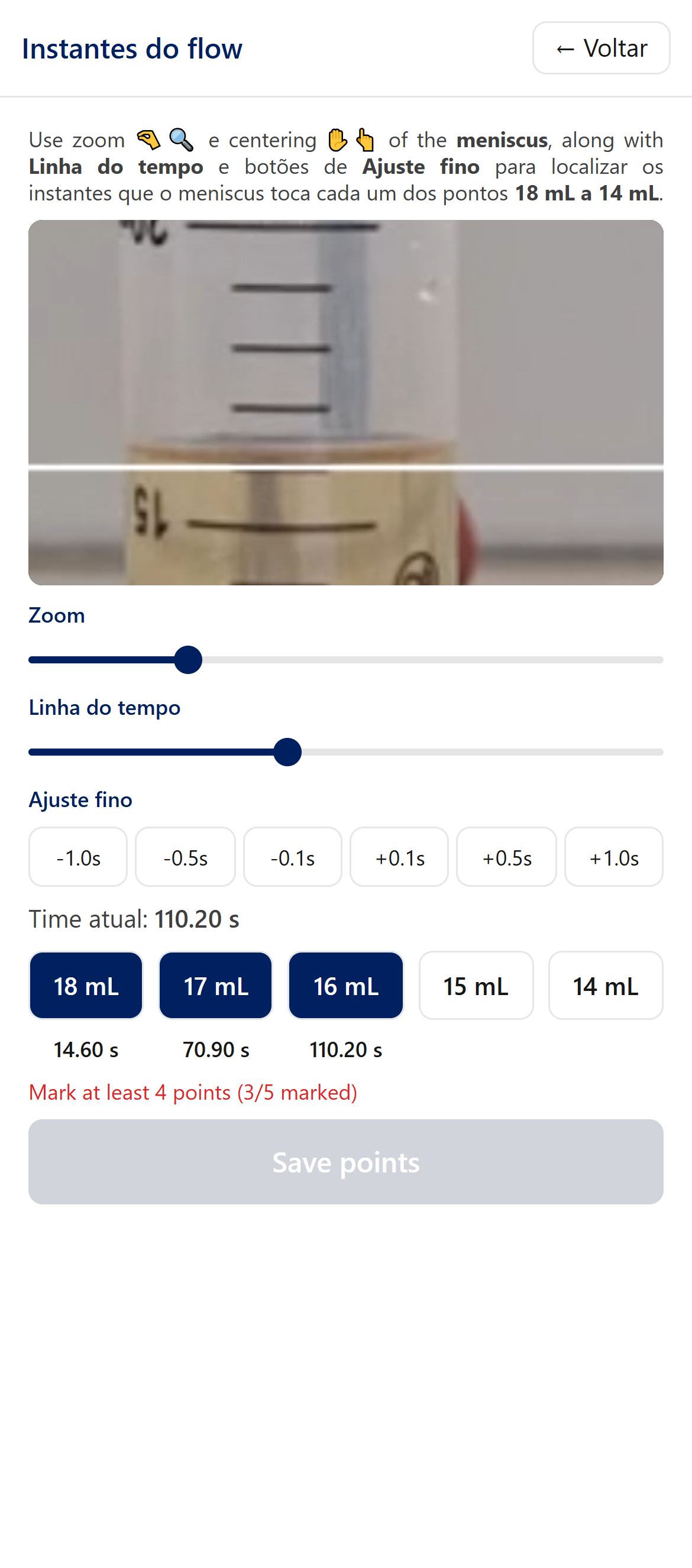
- Relative viscosity — ratio of the flow times of the sample and water in the same syringe (range 18 to 14 mL).

Alcohol content estimation
From the relative density and reference tables (Gay-Lussac, OIML), the app estimates the total alcohol mass fraction — regardless of whether it is ethanol and/or methanol, since both have very similar densities. Unit conversions (% v/v, °GL, INPM, % w/w) are performed automatically.
Ternary composition screening
Combines the relative density with the sample-to-water flow ratio, comparing it against a literature reference mesh (queried at a fixed 24 °C layer), to locate the compositions (pure substance, binary and/or ternary) most consistent with the user's measured values.
Statistical evaluation
The app evaluates the experimental uncertainty of the measurements, comparing the composition identified in the previous step with nearby compositions through a Z-test for mean comparison and Monte Carlo probabilistic simulation. The goal is to include nearby, statistically equivalent and/or probabilistically likely compositions.
Results report
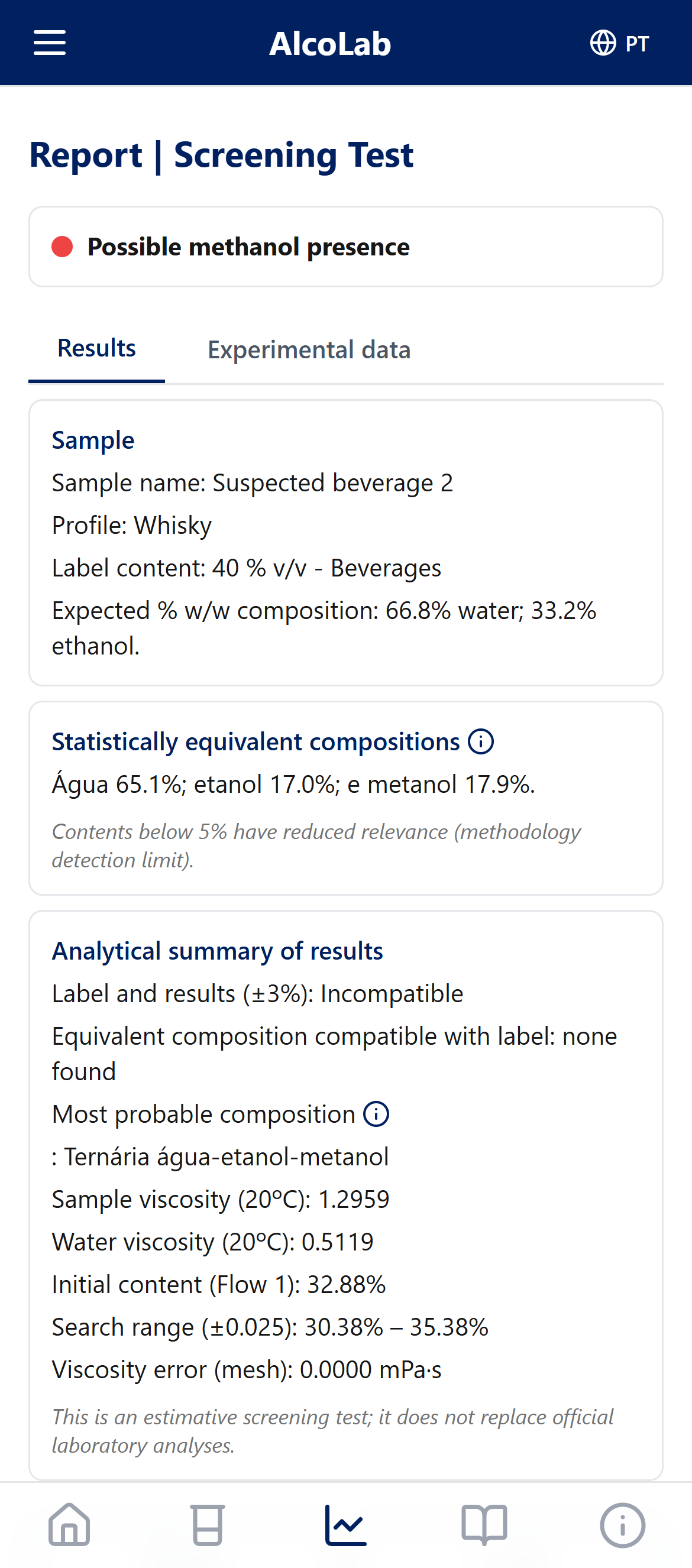
Equivalent and/or most likely compositions are compared with the declared label. The app organizes experimental measurements and results into a report and displays an immediate safety indicator in traffic light format (green / yellow / red). For example, when there is considerable probability of methanol presence and incompatibility with the label, the traffic light turns red.
Why AlcoLab exists
200+
suspected methanol poisoning cases in Brazil in a single outbreak (PAHO/WHO, 2025)
28
countries with active methanol risk alerts for beverages (UK Foreign Office, 2025)
$0
Cost per analysis with AlcoLab — versus $10,000+ for a gas chromatograph and hundreds of dollars per lab test
Despite the magnitude of the problem, practical detection remains largely restricted to laboratory settings. Selective techniques such as gas chromatography (GC-FID, GC-MS) require expensive instrumentation, unavailable to most field agents. Portable alternatives like Raman spectroscopy cost tens or hundreds of thousands of dollars. AlcoLab offers a radically accessible approach.
Who is it for
Health inspectors
Rapid field screening during inspections and seizures, supporting more targeted referral of samples to official laboratories with limited analytical capacity
Healthcare professionals
Preliminary screening of suspected beverages when attending patients with symptoms compatible with methanol poisoning, supporting timely clinical decisions while confirmatory results are unavailable
Investigators & forensic experts
Preliminary evidence in seizures and investigations
Distributors & retailers
Screening verification of suspicious batches or units
Consumers
Anyone, in any country, with access to the basic materials, provided they strictly follow the methodology indicated in the app
Try it before you use it
The authors have provided three demonstration scenarios with real date — including contaminated and legitimate samples — so you can explore the full analytical workflow before performing your own screening.

✅ Legitimate sample
🚨 Contamination detected
Scientific basis
AlcoLab combines two physical properties — relative density and relative viscosity — to estimate the ternary composition of water/ethanol/methanol solutions. Measurements are compared against a pre-computed reference mesh to obtain the most accurate composition from the experimental data. This composition is then tested against nearby compositions to evaluate equivalences and occurrence probabilities (Z-test and Monte Carlo simulation), considering the experimental uncertainty. This approach ensures that no other equivalent, possible and likely ternary composition (water-ethanol-methanol) is left out of the reported results, when one exists for the obtained data, beyond the most accurate one found in the mesh search.
All scientific processing occurs locally in the browser, using Python (NumPy, SciPy) executed via Pyodide (WebAssembly). No data is sent to external servers. Future versions will only do so with explicit user consent, to enable features such as epidemiological risk mapping and integration with health surveillance systems.
Team
Diego Mendes de Souza
Development, experiments & statistics
PhD in Chemometrics · Industrial Chemist · Official Forensic Expert · Chemistry Professor
Pedro Augusto de Oliveira Morais
Scientific review, experiments & statistics
PhD in Chemometrics · Industrial Chemist · Chemistry Professor — UFMA
Nayara Ferreira Santos
UX audit, co-holder & administrative management
Business Administrator · Co-founder of Científica Concursos
Romério Rodrigues dos Santos Silva
Collaborator · UX Reviewer · Experiments
PhD in Biochemistry · Biologist
Support the project
AlcoLab is maintained on a voluntary, nonprofit basis. To ensure its continuity and evolution — including recalibrations, external validations, building a collaborative database for adulteration mapping, and infrastructure maintenance — the project is open to support of different kinds.
Public funding
Innovation, public health, and open science grants
Institutional partnerships
Health organizations, universities, and reference laboratories
Corporate sponsorship
Companies in the beverage, food safety, and health sectors
Individual donations
Contributions of any amount
🇧🇷 Brazil — Pix
[email protected]🌍 Other countries
Buy Me a CoffeeSupport with ideas
Suggestions for improvements, new features, or adjustments are always welcome. All proposals are evaluated by the team and publicly tracked regarding their feasibility and implementation.
Submit a suggestionFor partnership or funding proposals, please contact us at [email protected]
Contact & partnerships
[email protected]Institutions, organizations, and companies interested in supporting, partnering, or integrating AlcoLab into their programs are welcome to get in touch.