April 8, 2026 · Diego Mendes de Souza
AlcoLab – Brazilian Researchers Create Free App That Helps Detect Methanol in Beverages
Free app helps detect methanol in beverages: AlcoLab is a solution created by Brazilian researchers to combat the global methanol poisoning crisis.
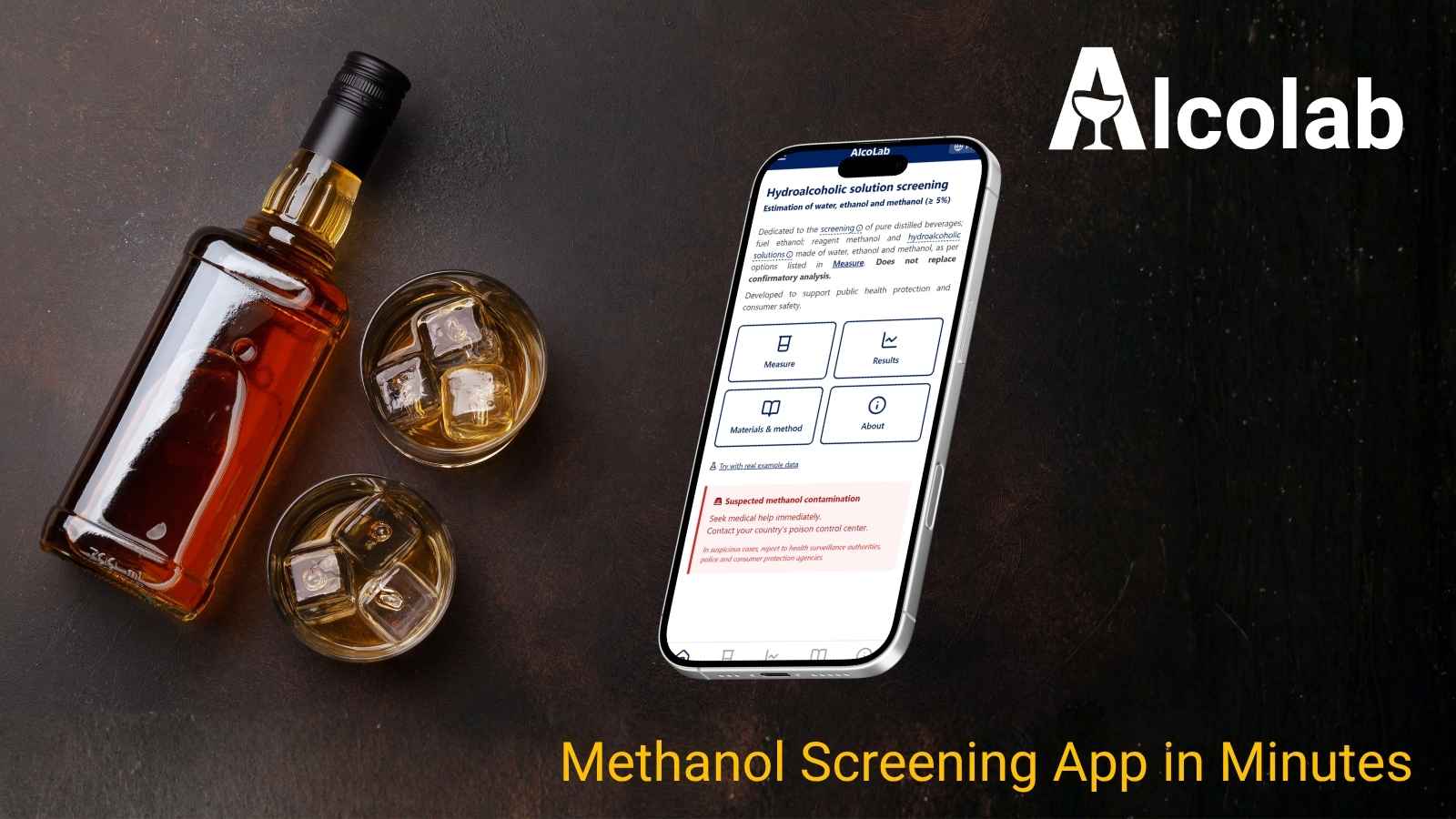
How Two Chemists and One Administrator Created a Free Tool Against Methanol – Asking Nothing in Return
In 2025, Brazil faced a severe outbreak of methanol poisoning in alcoholic beverages, reinforcing the urgent need to Detect Methanol in Beverages through accessible methods. Between September and December, dozens of people were hospitalized and more than 20 died — cases that were concentrated mainly in São Paulo, but not restricted to it.
It was in this context that Pedro Augusto de Oliveira Morais, PhD in Chemometrics, asked two simple questions to his colleague Diego Mendes de Souza, also a Chemist and Criminal Expert: Were methanol poisoning cases reaching forensics? Did he envision any way to detect the contaminant without depending on a laboratory equipped with expensive instruments and still Detect Methanol in Beverages reliably?
Diego didn't work directly with adulterated beverages — his work at the Civil Police focuses on drug analysis. But the question stuck and the desire to contribute to preventing new contaminations arose, especially by finding ways to Detect Methanol in Beverages outside traditional labs. And he began to research.
The Discovery Through Literature Data
First, Diego spent days researching in the scientific literature about the physical and chemical properties of ethanol and methanol. The two alcohols are very similar — so similar that most simple analysis methods cannot distinguish them safely. Density, for example, gives an excellent notion of total alcohol content, but does not discriminate whether that content comes from ethanol, methanol or a mixture of both, which makes it insufficient alone to Detect Methanol in Beverages.
In this regard, Diego identified a relevant difference: viscosity. Methanol is less viscous than ethanol and water. Therefore, when methanol is present, it flows faster, for example, through a viscometer. The property seemed simple, but could be what was missing to assemble an accessible methodology capable to Detect Methanol in Beverages. Therefore, he had the idea of adapting this flow to a simple and accessible device, a pharmacy syringe. Next came the idea of embedding this in an app that would help detect methanol. See what Diego explained in an interview with Olhar Digital:
Density does not discriminate methanol from ethanol. We measure density on a kitchen scale and it gives the initial notion of how much alcohol is in the mixture. Density gives a direction — and the solution embedded in AlcoLab refines that direction with viscosity obtained by flow. Since methanol is less viscous, it flows faster. We use the two variables in a complementary way to reach the conclusion of the most likely hydroalcoholic composition.
With literature data in hand, Diego began working informally at home — testing parameters, cross-referencing data, building a database to support the algorithm and methodological flowchart. In parallel, Pedro Augusto conducted experimental tests on his own to validate whether what the methodology indicated on paper was confirmed in practice. There was no formal project. There was no funding. There were two people using their own free time and spending money from their own pockets to see if the idea worked for methanol detection and ultimately to Detect Methanol in Beverages.
From Idea to Practical Solution: Entry of Nayara and Romério
When the tests began to show real potential, the team needed more than science - they needed a tool that anyone could use. That's when Nayara Ferreira Santos, Administrator, entered the project, contributing with the interface usability and the administrative structure of the initiative.
Moreover, one more person interested in volunteering appeared. Romério Rodrigues dos Santos Silva, Postdoctoral Researcher in Biochemistry, began to contribute to the tool's usability and also in more experimental tests of the tool.
The four worked for months without any external incentive. The costs of server hosting, materials for testing and commercial beverages purchased for calibration came out of their own pockets.
When the tool was practically ready, the team found itself facing a real choice: apply for a patent for a solution that helped detect methanol — a process that takes 2 to 7 years — or launch immediately, for free, to whoever needed it to Detect Methanol in Beverages.
They chose to launch.
The team opted to launch immediately and for free. There was no guarantee of return for the months of work invested — but there was the concrete possibility that the tool would arrive in time to be useful for those who need it: consumers, inspectors, distributors. For us, contributing to contain a serious public health problem weighed more than any other consideration.
So, AlcoLab went live on March 10, 2026.
How Methanol Screening Works - AlcoLab
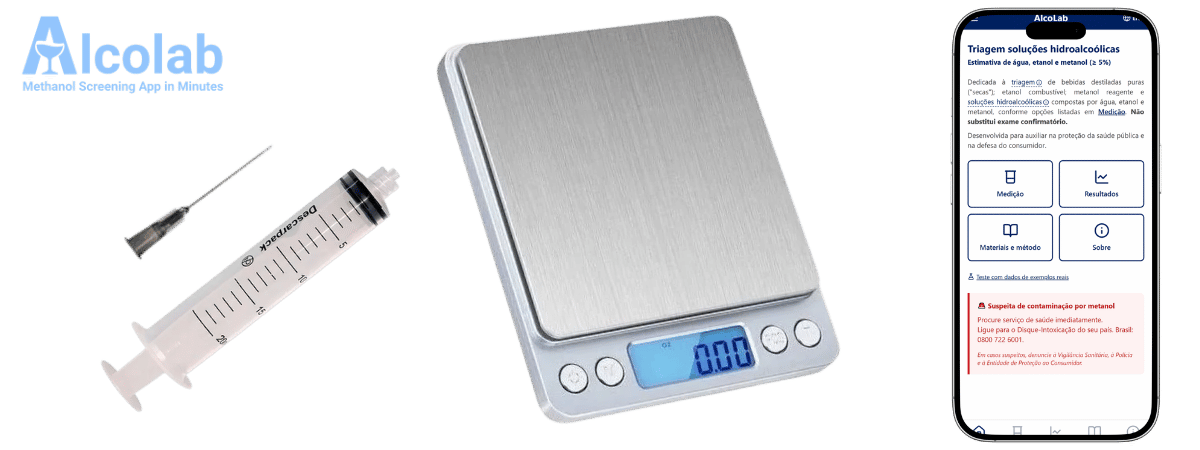
AlcoLab is a web application, accessible at alcolab.org, without the need for download to help detect methanol through screening (non-confirmatory) examination and enable users to Detect Methanol in Beverages in a practical way. The complete process takes between 15 and 25 minutes and requires only three items:
• a 20 mL syringe with 22G needle (the most common in pharmacies),
• a kitchen scale with 0.1g resolution (important, but it is possible to examine without it); and
• a smartphone with camera.
Its worth remembering that this is a screening and not confirmatory methodology. AlcoLab results do not completely replace confirmatory tests, but function as an auxiliary tool in screening for the presence of methanol. In suspicious cases, even if the result shows compatibility with the label, consumption is not recommended. Report to Health Surveillance, Police and Consumer Protection Agency.
Step-by-Step Methodology
- The user draws and weighs 20 mL of water and then 20 mL of the beverage being analyzed — this provides the relative density.
- Next, position the syringe vertically and film the flow of liquid between the 18 and 14 mL marks — this allows estimation of relative viscosity.
- With this data entered into the application, along with label information, the app flow estimates the alcohol content based on grids from the literature. It then searches in that content range, in an experimental grid developed by the authors, for the composition or compositions compatible with the obtained flow time, enabling users to Detect Methanol in Beverages more reliably.
Results Report and Statistics Applied by AlcoLab
- Statistics: The app evaluates the experimental uncertainty of measurements, comparing the composition identified in the previous step with compositions of nearby results through Z-test for comparison of means and Monte Carlo probabilistic simulation. The objective is to include nearby compositions, statistically equivalent and/or probabilistically likely.
- Results report: The equivalent and/or most likely compositions are compared with the declared label. The app organizes experimental measurements and results in a report and displays an immediate safety indicator in traffic light format (green / yellow / red). For example, when there is considerable probability for the presence of methanol and/or incompatibility with the label, the traffic light assumes a red color.
It's worth remembering that the tool only works with pure distillates — vodka, cachaça, whisky, rum, gin, tequila, aguardiente. It is not compatible, for now, with liqueurs, beers, wines or mixed drinks, because these have more diverse chemical composition that impacts the density and viscosity parameters.
The First Month of Availability
In about one month, the public website alcolab.org already had visits from almost 2500 users and about 34 thousand requests spread across all continents. With accesses in countries like Brazil, United States, China, France, Canada, Singapore and Switzerland. Moreover, the project appears in the first Google results both in Portuguese ("app triagem de metanol") and in English ("methanol screening app").
The international adoption shows something the team already suspected and WHO data pointed to: beverage contamination by methanol is not a problem and concern exclusively in Brazil. It is a global problem, especially in countries with little oversight and laboratory infrastructure — increasing the importance of tools that can Detect Methanol in Beverages worldwide.
What Lies Ahead for AlcoLab
In this regard, AlcoLab (app that helps detect methanol through screening) is still funded by the researchers themselves. Open source projects without institutional support face real risks: accumulated maintenance, vulnerable infrastructure, risk of abandonment by the authors. Therefore, the team that knows this history wants to avoid it.
For this reason, they seek partnerships in three fronts:
- technical validation,
- financial sustainability and
- tool improvement.
Among the institutions contacted by email are Doctors Without Borders (which maintains the Methanol Poisoning Initiative since 2012), PAHO/WHO, Fiocruz, MAPA, ANP, and local parliamentarians. In the field of funding, the authors are studying and planning submissions inside and outside the country.
No partnership is confirmed yet, but some negotiations are underway. Moreover, the project has been publicly available for a short time.
What is confirmed is what already exists: a functional, free, open source and auditable tool, created by three people who decided that solving the problem was more urgent than protecting the invention.
If this project makes sense to you, the simplest way to help is to share it with those who might benefit — a consumer, a producer, an inspector, someone working with food safety. And if you represent an institution that could support AlcoLab, or know someone who might, get in touch: [email protected]
AlcoLab is available at alcolab.org.Source code: github.com/diegoanapolis/alcolabContact: [email protected]
Want to test methanol screening now?
Access AlcoLab