April 8, 2026 · Diego Mendes de Souza
Methanol Screening App: Why AlcoLab's Creators Gave Up the Patent to Launch the Tool Immediately
A free, open source methanol screening app, self-funded. The story of those who decided that contributing to public health mattered more than any return.
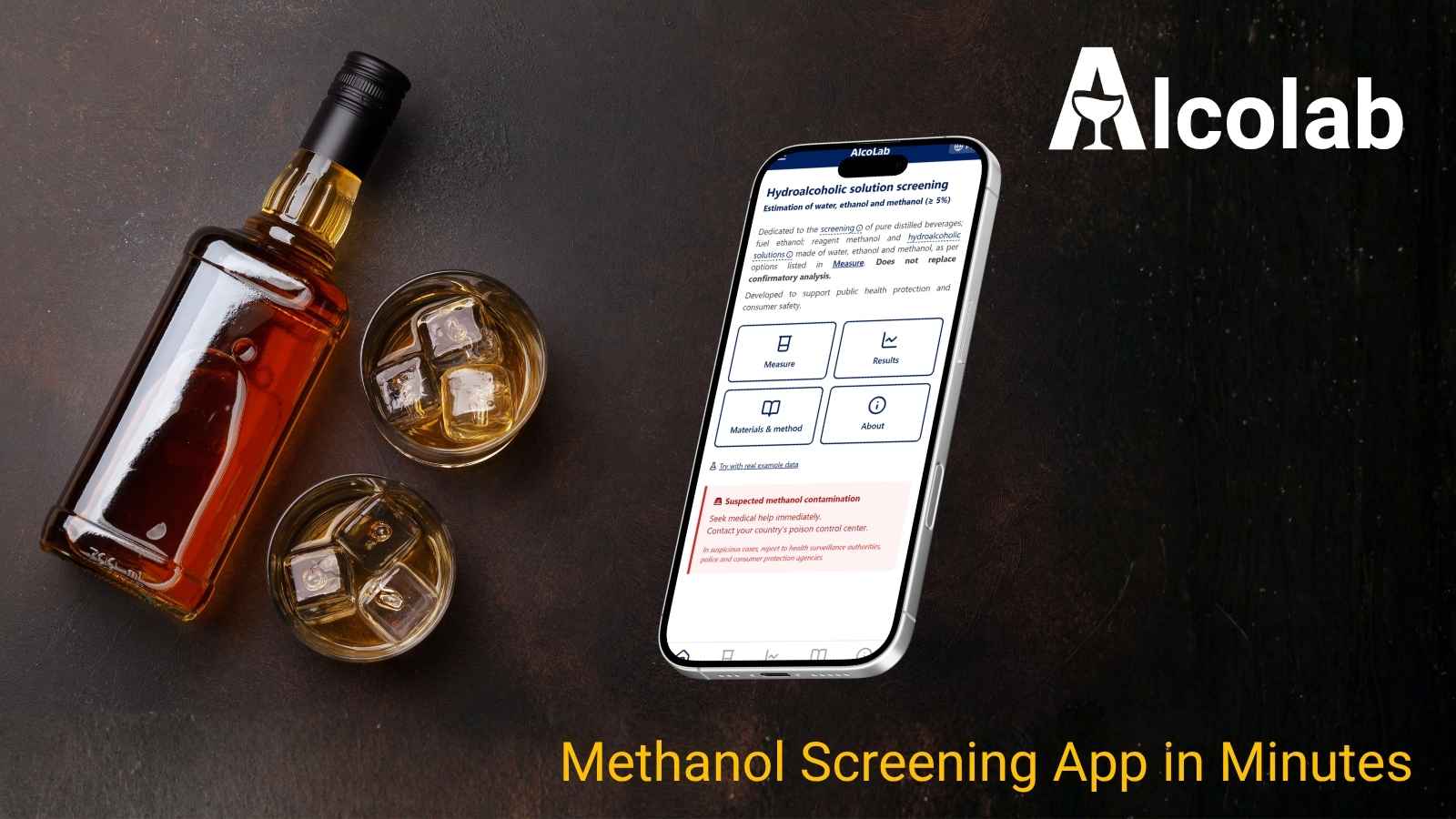
The crossroads
When the methodology was already structured and experimental tests confirmed the tool's potential, the team — Diego Mendes de Souza, Pedro Augusto de Oliveira Morais, Nayara Ferreira Santos, and Romério Rodrigues dos Santos Silva — had to decide what to do with what they had built (methanol screening app).
The first option would be to propose the instruments used as a minimum physical device and initiate a patent application. It would be the safest path to protect the invention and eventually obtain returns for the invention, study, and work invested.
The problem was that there was an active outbreak, in Brazil and beyond. People were being poisoned and some losing their lives. And the window between "finished idea" and "granted patent" could last years.
The second option was to launch immediately, for free, bearing the costs out of pocket — online server, domain, test materials, beverages for calibration — without any guarantee of return. They chose this second option.
What "open source" means in practice
AlcoLab (methanol screening app) was published under the AGPL-3.0 license — one of the most rigorous open source licenses available. It ensures that any derived version of the tool must also be open, preventing third parties from transforming the code into a proprietary product without making the modifications available.
Before public release, the team took two strategic steps:
- Filing with INPI — which establishes the priority date of the invention in Brazil; and
- Publication on Zenodo, an international scientific repository.
These registrations do not aim at commercial exploitation, but rather the opposite. In this sense, they aim to prevent another person or company from claiming the idea as their own after it has already been made public. It is, therefore, a protection oriented toward openness, not closure.
The complete code is available at github.com/diegoanapolis/alcolab. Anyone can review the methodology, audit the algorithm, suggest improvements, or adapt the tool for other contexts — as long as they maintain the same commitment to openness.
The real cost of being free
On the other hand, free software (methanol screening app) does not mean software without cost. It means someone is bearing it.
In AlcoLab's case, that bill was — and still is — paid by us creators. Server hosting, domain registration, commercial beverages purchased for experimental tests, materials for calibration, and many hours of research and work. Everything came out of the team's pocket, who worked for months without any external support.
In this context, the estimated costs so far are listed in the table below.
| Item | Details | Estimated Cost |
|---|---|---|
| Beverages for calibration | 10 labels (whisky and vodka) | US$ 200 |
| Chemical reagents | Ethanol and methanol (analytical grade), 10 L each | US$ 320 |
| Infrastructure — Railway Pro | US$ 20/month \times 6 months | US$ 140 |
| Development tools | GitHub Copilot + Claude Max, 6 months | US$ 768 |
| R&D hours | 290 h (Diego 150h · Pedro 80h · Romério 30h · Nayara 30h) | US$ 5,800 |
| Total estimated investment | US$ 7,228 |
This is possible while the stamina lasts. And the team is honest about the risks: open source projects without institutional support have a well-known history of burnout. Volunteer developers become overloaded, maintenance accumulates, updates stop being made, and infrastructure becomes vulnerable. The result is what the field calls abandonware — software that exists but no longer has anyone behind it.
This is exactly what the team wants to avoid, precisely because they believe in the tool's positive impact on public health.
Why openness matters for a public health tool
The reference method for detecting methanol in beverages is Gas Chromatography (GC) — a high-precision, accuracy, and discrimination technique that separates and identifies the components of a mixture reliably. GC equipment, depending on configuration, costs between R 600 thousand. In this sense, most Brazilian municipalities do not have this type of equipment available — and most countries affected by beverage contamination do not either.
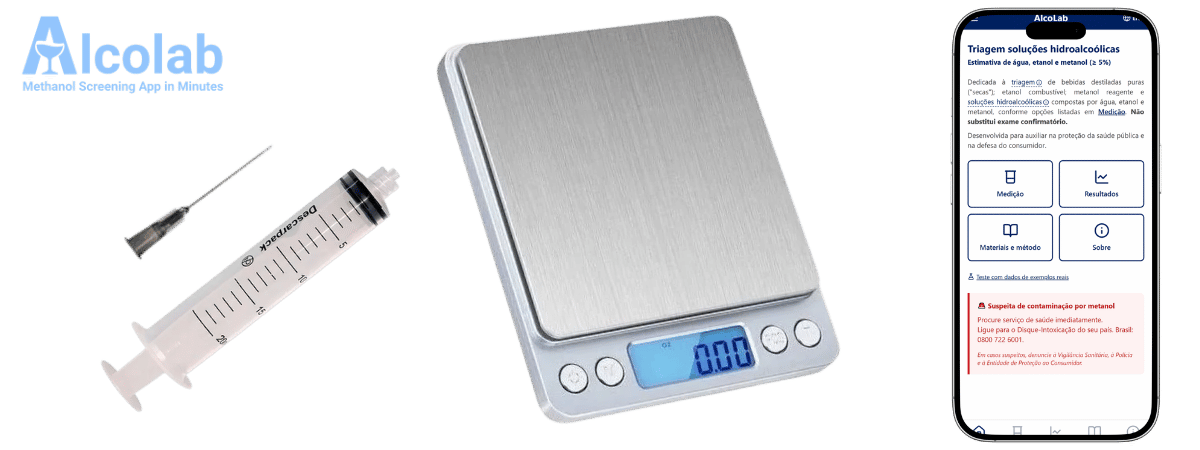
When analysis depends on equipment that only exists in capitals or large research and forensic centers, screening capacity during a crisis is geographically restricted. This is the gap that AlcoLab tries to address: a tool that uses a pharmacy syringe; a kitchen scale with minimum resolution of 0.1g; and a cell phone with a camera; accessible to most people.
| Gas chromatography (GC-MS/FID) | AlcoLab | |
|---|---|---|
| Equipment cost | > R$ 200 thousand | ~ R$ 0 |
| Materials per test | Specialized reagents and standards | Syringe + scale |
| Cost per analysis (3 rep. + blank) | R 1.400 | ~ R$ 0 |
| Time to result | Hours to days | 15 – 25 min |
| Access | Specialized laboratories | Anyone |
| Confirmatory | Yes | No (screening) |
In this sense, making it open was not just a statement of values — it was also a consistent and practical decision. Reliable code and methodology need to be auditable, especially when talking about health. Transparent methodology can be verified by other researchers and technicians in the field, as we desire. And a free tool reaches exactly those who need it most: inspection agents in regions with little infrastructure, small producers, distributors, and even consumers.
The first results
In about one month of public website, AlcoLab (methanol screening app in distilled beverages) registered almost 2,500 unique visitors and approximately 34 thousand server requests, with access from all continents — Brazil, United States, China, France, Canada, Singapore, and Switzerland, among others.
These numbers confirm what the team already suspected: the problem is not Brazilian. Methanol contamination of beverages affects, therefore, dozens of countries, especially where inspection and laboratory infrastructure are limited. An open solution has, by definition, reach that a proprietary solution would hardly have.
What the team seeks now
The project's sustainability depends on partnerships. The team seeks support on three fronts: (1) technical validation, (2) financial maintenance, and (3) continuous improvement of the tool.
At the international level, Doctors Without Borders — which has maintained the Methanol Poisoning Initiative since 2012 —, PAHO/WHO, foundations like Wellcome Trust and Gates Foundation, and organizations like IDB Lab and STDF were contacted. At the national level, the list includes Fiocruz, MAPA, ANP, health surveillance, and parliamentarians. Moreover, in the field of research funding, there are planned submissions to FAPEMA, FINEP, and FAP-DF.
In this sense, no partnership is closed yet. The project is recent and negotiations are underway. On the other hand, what exists concretely is the tool itself: functional, free, auditable, available now.
A final note
The choice to open the code and launch for free was not painless. It means giving up any direct return for the work done. It means continuing to bear the costs without knowing for how long. It means, therefore, betting that collective impact is worth more than individual protection of the invention.
For the AlcoLab team, the possibility that the tool would arrive in time — to consumers, inspectors, distributors, health agents — weighed more than the security of a business model that would still take years to materialize.
This is not a manifesto. It is just what happened.
AlcoLab is available at alcolab.org. Source code: github.com/diegoanapolis/alcolab
If this project makes sense to you, the most direct way to help is to share it with those who might benefit — a consumer, a producer, an inspector, someone who works with food safety. And if you represent an institution that could support AlcoLab, or know someone who might, get in touch: [email protected]
Want to test methanol screening now?
Access AlcoLab